The Asian Games are the continent’s premier multi-sport competition. During this event, thousands of elite athletes push their bodies to physical limits. However, operating at peak athletic capacity creates an unavoidable risk of severe injuries. Because high training loads create immense stress, tracking injury profiles provides crucial insight into modern sports performance. For example, recent Asian Games cycles featured several high-profile stars who suffered unexpected physical setbacks. Some sustained injuries in training, while others suffered damage directly on the field. Therefore, this detailed analysis evaluates these big-name athletes, their clinical conditions, their recovery timeframes, and their prospects.
1. Neeraj Chopra (India) – Javelin Throw
The Injury Profile
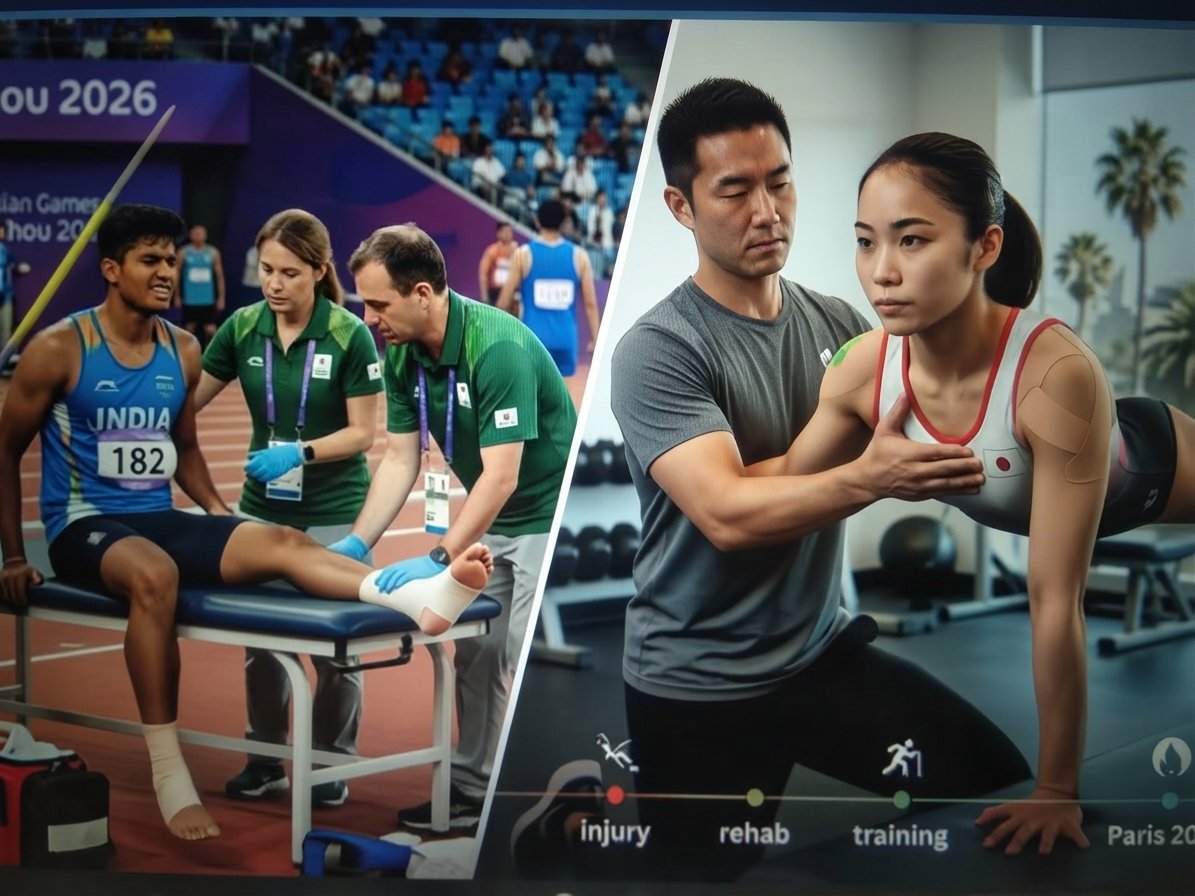
Neeraj Chopra, the reigning Olympic champion, suffered a severe ankle ligament tear during an intense training session after his performance at the Lausanne Diamond League. Because the javelin throw imposes extreme forces on the lower body, the plant leg absorbs weight equal to six times his total body mass within milliseconds. As a result, this structural ligament tear destabilized his ankle joint. Consequently, he could not execute explosive runway approaches or sudden stops safely.
Recovery Timeline & Rehabilitation Path
- Diagnosis: High-grade ankle ligament tear (lateral ligament complex/syndesmosis disruption).
- Recovery Duration: 4 to 6 months.
- Rehabilitation Strategy: First, medical staff mandated non-weight-bearing immobilization. Next, physical therapists restored his joint mobility. Finally, trainers reintroduced plyometric jumping drills along the runway.
Future Event Participation
Chopra withdrew from the remainder of the track season. However, because he possesses strong biological resilience, experts expect a complete recovery. Therefore, he remains on track to compete at the World Athletics Championships and lead India’s team at the Los Angeles 2028 Olympics.
2. Shinnosuke Oka (Japan) – Gymnastics
The Injury Profile
Shinnosuke Oka, the gold medalist from Paris, entered the Asian Games cycle with a lower-body strain and chronic lumbar spine inflammation. Because artistic gymnastics demands extreme back extension, high landings, and core rigidity, overuse injuries damage structural vertebrae. Furthermore, these muscle micro-tears prevent an athlete from executing hard routines on the vault and floor exercise.
Recovery Timeline & Rehabilitation Path
- Diagnosis: Lumbar spine disc strain and lower-limb muscle strain.
- Recovery Duration: 3 to 5 months.
- Rehabilitation Strategy: Initially, therapists used core stabilization routines and spinal decompression. In addition, coaches used soft landing mats before moving him to hard competition floors.
Future Event Participation
Oka’s management team took a cautious approach to protect his career. Although coaches reduced his difficulty scores during recent events, analysts predict a complete recovery. Consequently, he will return in time for the World Championships and defend his titles at LA 2028.
3. Yashas Palaksha (India) – Athletics (400m Hurdles)
The Injury Profile
During his 400m hurdles race at the Asian Games, Yashas Palaksha pulled up suddenly and grabbed his posterior thigh. Because high-speed hurdling requires rapid muscle extension from the hamstring, the intense load caused an acute strain. As a result, Palaksha stopped running and exited the track immediately.
Recovery Timeline & Rehabilitation Path
- Diagnosis: Acute Grade-2 Biceps Femoris (Hamstring) Muscle Tear.
- Recovery Duration: 8 to 12 weeks.
- Rehabilitation Strategy: First, doctors applied ice, compression, and elevation. Afterward, therapists added soft-tissue massage and eccentric strengthening exercises. Finally, coaches restarted sprinting drills after muscle strength reached normal levels.
Future Event Participation
Palaksha will miss the immediate post-Games track meets. However, because an 8-to-12-week recovery window gives him enough healing time, doctors expect to give him full medical clearance. Therefore, he will join the national trials for the upcoming Asian Athletics Championships.
4. Ahn Young-jun (South Korea) – Basketball
The Injury Profile
South Korean basketball MVP Ahn Young-jun suffered a high-grade ankle injury during practice matches. Because professional basketball involves constant jumping, hard landing, and quick directional cuts, players face significant risk of ankle damage. Consequently, team managers removed him from the official roster.
Recovery Timeline & Rehabilitation Path
- Diagnosis: High Ankle Sprain (Syndesmotic Ligament Strain).
- Recovery Duration: 2 to 3 months.
- Rehabilitation Strategy: First, medical staff used protective joint bracing. Meanwhile, therapists prescribed hydrotherapy workouts to maintain cardiovascular fitness. Later, trainers introduced lateral agility drills.
Future Event Participation
Moon Jung-hyun replaced Ahn on the national squad. Nevertheless, Ahn expects to finish his rehabilitation program during the domestic season. Furthermore, he will remain available for future FIBA World Cup qualifying games.
Summary Matrix of Athlete Injuries and Recovery Status
| Athlete Name | Country | Sport | Specific Injury | Est. Recovery Time | Next Target Event |
| Neeraj Chopra | India | Athletics (Javelin) | Ankle Ligament Tear | 4 – 6 Months | World Athletics Championships / LA 2028 |
| Shinnosuke Oka | Japan | Gymnastics | Lumbar Spine/Lower-Body Strain | 3 – 5 Months | World Gymnastics Championships |
| Yashas Palaksha | India | Athletics (400m Hurdles) | Grade-2 Hamstring Strain | 8 – 12 Weeks | Asian Athletics Championships |
| Ahn Young-jun | South Korea | Basketball | High Ankle Syndesmosis Sprain | 8 – 10 Weeks | KBL Domestic Season / FIBA Qualifiers |
Physiological Recovery Mechanisms and Risk Management
The high frequency of injuries during major tournaments like the Asian Games reflects the extreme physical demands of modern sports. When elite competitors combine heavy training schedules with long-distance travel, central nervous system fatigue builds up rapidly.
Because fatigue compromises nervous system coordination, optimal running mechanics break down. As a result, even a tiny alignment error transfers heavy force onto surrounding soft tissues. Consequently, athletes suffer painful muscle pulls, joint tears, and stress fractures.
Key Steps for Successful Return-to-Play Protocols:
- Movement Realignment: Therapists fix mechanical movement errors to protect adjacent joints.
- Load Control: Trainers use modern GPS tracking to avoid sudden spikes in training volume.
- Psychological Confidence: Counselors help athletes overcome fear so that they perform without hesitation.
Final Verdict on Future Competitions
Losing top stars during the Asian Games frustrates sports fans across the world. However, modern rehabilitation techniques guarantee that these specific injuries will not end careers. Because these stars have structured recovery plans, Neeraj Chopra and Shinnosuke Oka will regain peak performance. Therefore, they will compete successfully at upcoming World Championships and challenge for gold medals at the LA 2028 Olympic Games.
Frequently Asked Questions (FAQs)
1. Which major athletes suffered injuries at the Asian Games?
Several high-profile athletes suffered severe injuries during recent Asian Games cycles. Specifically, Indian javelin champion Neeraj Chopra suffered an ankle ligament tear, while Japanese gymnast Shinnosuke Oka battled lumbar spine strain. In addition, Indian hurdler Yashas Palaksha sustained a grade-2 hamstring strain, and South Korean basketball star Ahn Young-jun suffered a high ankle sprain.
2. How long will it take these elite athletes to recover?
Recovery timelines depend on the specific structural damage sustained by each athlete. For example, muscle strains like Yashas Palaksha’s hamstring pull require 8 to 12 weeks of structured rehabilitation. However, severe ligament disruptions, such as Neeraj Chopra’s ankle injury, demand 4 to 6 months of non-weight-bearing recovery and targeted physical therapy.
3. Will injured athletes like Neeraj Chopra compete in the LA 2028 Olympics?
Yes, doctors and sports scientists expect these athletes to make a full physical recovery. Because their rehabilitation plans give them sufficient time to heal, stars like Neeraj Chopra and Shinnosuke Oka remain on track to compete at upcoming World Championships and challenge for gold medals at the Los Angeles 2028 Olympic Games.
4. What causes the high rate of injuries during major multi-sport events?
Extreme physical exertion combined with heavy training schedules creates rapid nervous system fatigue. When fatigue degrades muscular control, biomechanical form breaks down slightly. As a result, even minor joint misalignment transfers massive impact forces onto surrounding soft tissues, consequently causing severe muscle strains, joint sprains, and stress fractures.
5. How do sports medical teams ensure a safe return to competition?
Medical staff utilize a three-step return-to-play protocol to ensure complete physical recovery. First, physical therapists correct movement compensations to protect secondary joints. Next, sports scientists use GPS devices and force plates to control training workloads. Finally, sports psychologists help athletes rebuild mental confidence so that they perform without fear of re-injury.