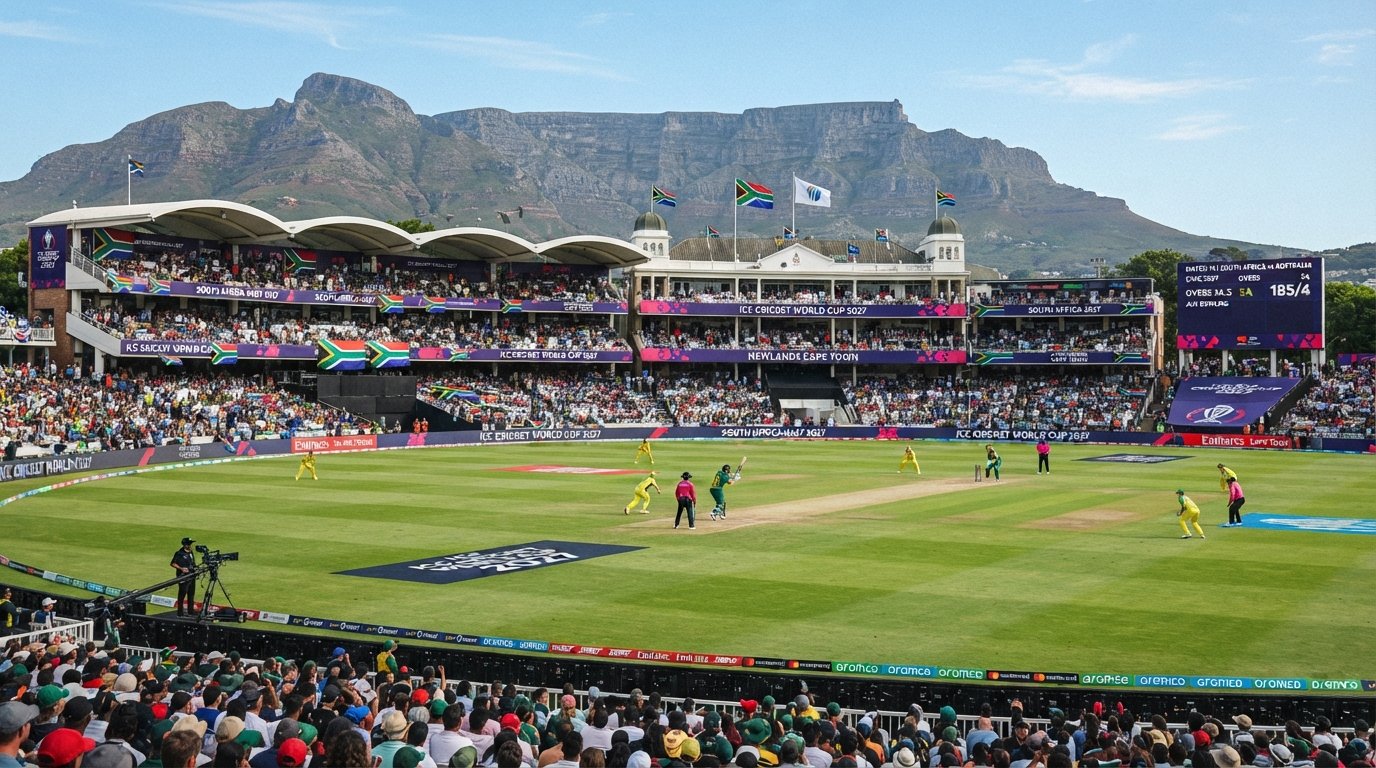
The 2027 ICC Men’s Cricket World Cup will bring the biggest 50-over cricket tournament back to Africa when South Africa, Zimbabwe and Namibia jointly host the competition from 2 October to 21 November 2027. The tournament will be the 14th edition of the ICC Men’s Cricket World Cup and will feature 14 teams competing across 57 matches and 12 venues. It will also mark the return of the men’s ODI World Cup to Africa for the first time since the 2003 edition.
The 2027 tournament will have a new format compared with recent editions. The competition will begin with a three-team Super Series in Namibia before the main group stage. The 12 teams in the group stage will be divided into two groups of six, followed by a Super 7 stage and then the semi-finals and final.
With the world’s leading ODI teams preparing for the event, the 2027 World Cup promises another major chapter in the history of international cricket.
Cricket World Cup: Dates and Host Countries
The ICC has confirmed that the tournament will begin on 2 October 2027, while the final is scheduled for 21 November 2027.
The three host countries are
- South Africa
- Zimbabwe
- Namibia
The tournament will use 12 venues across the three countries. South Africa will provide eight venues, Zimbabwe three, and Namibia one.
The South African venues include Johannesburg, Tshwane, Cape Town, Durban, Gqeberha, Bloemfontein, Paarl, and KuGompo City. Zimbabwe will host matches in Harare, Bulawayo, and Victoria Falls, while Namibia’s capital, Windhoek, will host the opening Super Series.
This will be particularly significant for Namibia because it will host matches at a senior ICC World Cup for the first time. The tournament also represents an important return for Zimbabwe, which is set to return to the men’s World Cup after a 12-year absence.
Which Teams Will Participate in the 2027 World Cup?
The 2027 World Cup will feature 14 teams.
South Africa and Zimbabwe qualified directly as co-hosts. Eight additional teams gained automatic qualification based on their positions in the ICC ODI Team Rankings at the 30 September 2026 cut-off. The remaining four places will be decided through the Cricket World Cup Qualifier.
The confirmed/pre-seeded group structure announced by the ICC includes:
Group A
- India
- Australia
- Pakistan
- Afghanistan
- Zimbabwe
- Qualifier A
Group B
- New Zealand
- South Africa
- Sri Lanka
- England
- Bangladesh
- Qualifier B
Two additional teams will enter through the qualification pathway, and the Super Series will determine the final team progressing into the main Group Stage.
This means the final participating line-up will depend on the Cricket World Cup Qualifier and the three-team Super Series in Namibia.
How Will the 2027 World Cup Format Work?
The 2027 competition will have an interesting three-stage structure.
First, the three teams finishing in the relevant qualification positions will play a Super Series in Namibia. The matches are scheduled for 2, 4, and 6 October. The team finishing top will advance to the main group stage.
The next stage will contain 12 teams divided into two groups of six.
Each team will play the other five teams in its group once. The top three teams from each group will qualify for the Super 7 stage. The better-performing fourth-placed team across the two groups will also qualify, creating a seven-team Super 7 competition.
The Super 7 stage will consist of 21 matches. The four best teams will then qualify for the semi-finals.
The semi-final structure will be:
- 1st place vs. 4th place
- 2nd place vs. 3rd place
The winners will meet in the World Cup final on 21 November 2027.
Preparations for the 2027 Cricket World Cup
Preparation for a World Cup begins years before the first ball is bowled. Teams will need to manage player workloads, build their ODI squads, identify dependable combinations, and adapt to conditions in southern Africa.
For batting teams, South African conditions can provide an interesting challenge because pitches may offer pace and bounce. Zimbabwe and Namibia will provide different playing conditions, meaning teams will need flexible bowling attacks and adaptable batting orders.
The host countries are also preparing their venues and infrastructure. Twelve venues have been selected across the three nations, giving the tournament a broad geographical footprint.
South Africa has extensive experience hosting major international cricket events, while Zimbabwe has previously co-hosted the World Cup. Namibia’s involvement is particularly historic because it will stage its first senior men’s ICC World Cup matches.
The ICC has described the event through the theme “Three Nations, One Heartbeat,” reflecting the shared hosting responsibilities of South Africa, Zimbabwe, and Namibia.
Historical Background of the Cricket World Cup
The men’s Cricket World Cup began in 1975 in England. The first tournament had eight teams, and matches were played over 60 overs per innings. The West Indies became the first world champions after defeating Australia in the final at Lord’s.
The West Indies successfully defended their title in 1979, again defeating England in the final.
In 1983, India produced one of the greatest upsets in World Cup history. Kapil Dev’s team defeated the two-time defending champions West Indies by 43 runs at Lord’s, giving India its first World Cup title.
Australia won its first World Cup in 1987. Pakistan became champions in 1992 under Imran Khan, while Sri Lanka won its first title in 1996 under Arjuna Ranatunga.
Australia then entered a dominant era, winning the 1999, 2003, and 2007 tournaments. The Australian side became the first team to win three consecutive World Cups.
India won again in 2011 under MS Dhoni. Australia returned to the top in 2015, while England won its first men’s World Cup in 2019 after one of the most dramatic finals in cricket history.
Australia then won the 2023 World Cup in India, defeating the hosts in the final and securing a record-extending sixth title.
Cricket World Cup Winners and Winning Captains
Here is the complete list of men’s Cricket World Cup winners from 1975 through 2023:
| Year | Winner | Runner-up | Winning Captain |
|---|---|---|---|
| 1975 | West Indies | Australia | Clive Lloyd |
| 1979 | West Indies | England | Clive Lloyd |
| 1983 | India | West Indies | Kapil Dev |
| 1987 | Australia | England | Allan Border |
| 1992 | Pakistan | England | Imran Khan |
| 1996 | Sri Lanka | Australia | Arjuna Ranatunga |
| 1999 | Australia | Pakistan | Steve Waugh |
| 2003 | Australia | India | Ricky Ponting |
| 2007 | Australia | Sri Lanka | Ricky Ponting |
| 2011 | India | Sri Lanka | MS Dhoni |
| 2015 | Australia | New Zealand | Michael Clarke |
| 2019 | England | New Zealand | Eoin Morgan |
| 2023 | Australia | India | Pat Cummins |
The ICC identifies Australia as the most successful nation in World Cup history, with six titles. West Indies and India have won two each, while Pakistan, Sri Lanka, and England have one title apiece.
West Indies: The First World Champions
The West Indies dominated the first two editions.
In 1975, Clive Lloyd’s team defeated Australia by 17 runs in the final. Lloyd played a major role by scoring a century in the first World Cup final.
Four years later, the West Indies again defeated England to retain the trophy. Clive Lloyd therefore became the first captain to win the World Cup twice.
The West Indies reached the 1983 final as defending champions but lost to India.
India: Kapil Dev’s Historic 1983 Triumph
India’s 1983 victory changed the country’s cricketing history.
Kapil Dev led India to a famous 43-run victory over the West Indies at Lord’s. India had been considered an underdog before the tournament, but its bowling and fielding helped produce one of the competition’s most memorable upsets.
Kapil Dev became the first Indian captain to lift the World Cup.
India had to wait 28 years for its next title.
Australia: The Most Successful World Cup Team
Australia has won the World Cup six times, making it the most successful team in the tournament’s history. Its titles came in 1987, 1999, 2003, 2007, 2015, and 2023.
Allan Border captained Australia to its first title in 1987.
Steve Waugh then led Australia to victory in 1999.
Ricky Ponting captained the team to consecutive titles in 2003 and 2007. He is one of only two captains, alongside Clive Lloyd, to lift the World Cup twice as captain.
Michael Clarke captained Australia to the 2015 title on home soil.
The most recent Australian triumph came in 2023 under Pat Cummins. Australia defeated India in the final in Ahmedabad, with Travis Head producing a memorable century during the successful chase.
Pakistan’s 1992 World Cup Victory
Pakistan’s only men’s World Cup title came in 1992 under Imran Khan.
The tournament was played in Australia and New Zealand, and Pakistan overcame a difficult start before reaching the final against England.
Imran Khan’s leadership became one of the defining stories of the tournament. His team defeated England in the final and gave Pakistan its first and only World Cup title so far.
For Pakistan, the 1992 triumph remains one of the most important moments in the country’s sporting history.
Sri Lanka’s Breakthrough in 1996
Sri Lanka won its first World Cup in 1996 under Arjuna Ranatunga.
The team developed an aggressive approach at the top of the order, with Sanath Jayasuriya and Romesh Kaluwitharana helping redefine opening batting in ODI cricket.
Sri Lanka defeated Australia in the final and became the first team from the island nation to win the men’s World Cup.
India’s Second World Cup in 2011
India’s second World Cup victory came in 2011 under MS Dhoni.
India defeated Sri Lanka in the final in Mumbai. Dhoni produced an unbeaten 91 and finished the match with a famous six as India chased down Sri Lanka’s total.
The victory made Dhoni only the second Indian captain after Kapil Dev to lift the World Cup.
England’s First World Cup in 2019
England won its first men’s Cricket World Cup in 2019 under Eoin Morgan.
The final against New Zealand at Lord’s became one of the most dramatic matches in cricket history. Both teams finished their 50 overs level, and the Super Over also ended level. England were ultimately declared winners on boundary countback under the rules used at the time.
The result gave England its first men’s 50-over World Cup title.
Australia Returns to the Top in 2023
Australia won its sixth World Cup in 2023 under Pat Cummins.
India entered the final as the host nation and tournament favourite after an outstanding group-stage campaign. Australia, however, produced a strong performance in the final and chased down India’s total.
Travis Head scored 137, becoming the seventh player to score a century in a men’s World Cup final.
Pat Cummins therefore became the latest captain to lift the World Cup trophy.
What to Expect From the 2027 World Cup
The 2027 tournament could provide a very different challenge from the 2023 edition.
The return to African conditions will test teams against pace, bounce, movement and changing weather conditions. The involvement of three host nations also means fans will experience different cricketing environments across South Africa, Zimbabwe and Namibia.
India, Australia, Pakistan, England, New Zealand, South Africa and Sri Lanka will be among the major teams attracting global attention, while Afghanistan and Bangladesh could also play an important role in the competition.
The new Super 7 format should create additional opportunities for teams to recover from a poor start and make a late push toward the semi-finals.
World Cup: A New Chapter in Cricket History
The 2027 ICC Cricket World Cup will combine the history of the world’s oldest major ODI competition with a new tournament structure.
South Africa and Zimbabwe already have World Cup hosting experience from 2003, while Namibia will enter a new chapter by hosting senior men’s World Cup matches for the first time. The event will also return the men’s World Cup to Africa after 24 years.
With 14 teams, 57 matches, 12 venues and a final scheduled for 21 November, the tournament is expected to become one of the biggest sporting events of 2027.
The historical record adds another layer of excitement. Australia will attempt to defend its position as the most successful World Cup nation, India will look for a third title, Pakistan will aim to repeat its 1992 success, and South Africa will have the opportunity to challenge for a first men’s World Cup trophy on home soil.
FAQs
- When is the 2027 ICC Cricket World Cup?
The 2027 ICC Cricket World Cup is scheduled to take place from 2 October to 21 November 2027. - Which countries will host the 2027 Cricket World Cup?
South Africa, Zimbabwe and Namibia will jointly host the 2027 ICC Cricket World Cup. - How many teams will play in the 2027 Cricket World Cup?
The 2027 World Cup will feature 14 teams competing across 57 matches. - Who are the past Cricket World Cup winners?
Australia has won the most men’s Cricket World Cup titles with six. Other winners are West Indies, India, Pakistan, Sri Lanka and England. - Who was the captain of the last Cricket World Cup winning team?
Pat Cummins was Australia’s captain when they won the 2023 ICC Cricket World Cup, defeating India in the final.