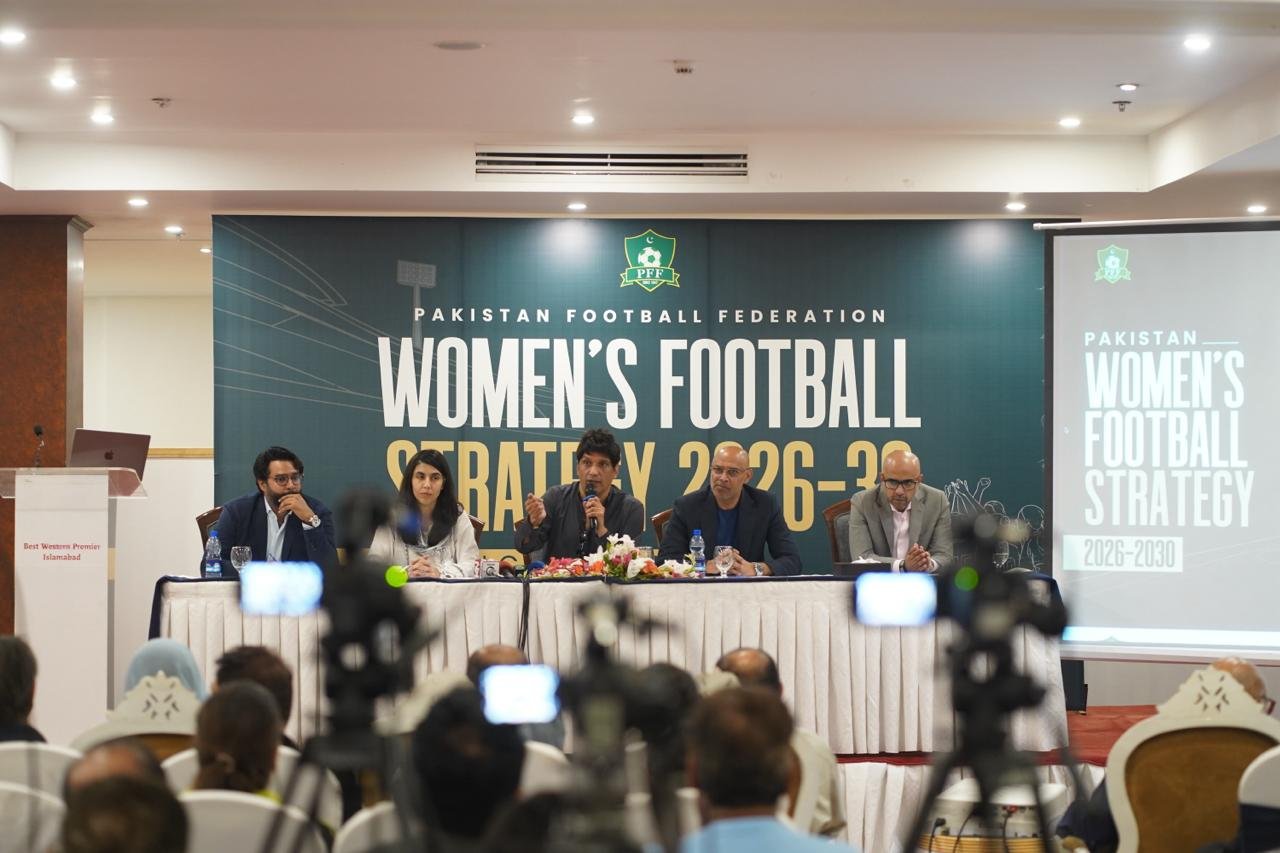
The Pakistan Football Federation (PFF) has launched the Pakistan Women’s Football Strategy 2026-2030 in Islamabad. The plan is a national framework for women’s football in Pakistan. It covers every level, from grassroots participation to the elite game. Launched under the theme “From Paper to the Pitch,” the strategy rests on five pillars. In addition, it creates lasting pathways for players, coaches, referees, administrators, and leaders. Currently, Pakistan has 62 registered clubs and academies and 673 registered female players. In short, the PFF aims to build a connected system that helps young girls progress from local pitches to the national team.
The strategy rests on five connected pillars:
- Participation and Competitions
- Player Development and High-Performance
- Education and Capacity Development
- Visibility, Engagement, and Growth
- Governance and Leadership
Building on What Exists
The strategy starts with the current state of the game. Pakistan has 62 registered clubs and academies. In addition, there are 673 registered female players and five certified women referees. However, the last AFC “A” Licence coaching course for women took place in 2020.
Head of Women’s Football Mejzgaan Orakzai presented the plan. She admitted the landscape is challenging. Still, she sees real room for growth. “This is not about starting from zero,” she said. “It is about building upon and strengthening what already exists.”
A Historic Moment
PFF President Syed Mohsen Gilani said the launch came at a landmark time. “This is a historic year for Pakistan women’s football,” he said. “Our women’s team has created history by participating in a FIFA event. The women’s team is now ranked higher than the men’s team.” He also congratulated the players, coaches, and staff behind this success.
Gilani explained that the strategy has three priorities. First, it aims to improve national team performance. Second, it invests in youth development. Third, it builds a broader ecosystem around the women’s game.
“We need to produce players, but we also need coaches, referees, managers, and leaders,” he said. “I pledge that we want to create an ecosystem for women’s football where they can become whatever they want to be within the game.”
Moreover, Gilani highlighted two recent steps. The PFF’s Football for Schools program emphasized women’s training. The federation also appointed a woman as its safeguarding officer.
Pillar One: Participation and Competitions
The first pillar is about access. To begin with, the strategy proposes expanded grassroots and youth competitions. It also suggests a tiered women’s league structure across national, provincial, and district levels. Furthermore, a comprehensive player registration system and a national talent identification framework will support these competitions.
“The pathway has to begin with access,” Orakzai said. “We want more girls playing football in schools, clubs, and academies. We want more regular competitions. We also need a system that can identify talent wherever it exists.”
Pillar Two: Player Development and High Performance
The second pillar links youth development with elite performance. Therefore, the strategy proposes regional training centers and national youth programs. It also introduces a Women’s National Team High-Performance Framework. Youth teams will gain regular international exposure. Meanwhile, the senior national team will play at least 10 international matches each year.
“High performance cannot be separated from the development system beneath it,” Orakzai said. “We need to identify players earlier and monitor their progression. Then we must provide them with the coaching, competition, and support they need to reach the highest level.”
Pillar Three: Education and Capacity Development
The third pillar focuses on the people who make the game work. It includes a national women’s coach education pathway. It also covers referee development programs and leadership opportunities for women. As a result, the strategy sets two clear targets:
- Train and certify at least 250 female coaches across four regions
- Raise the number of registered female referees to 100
Pillar Four: Visibility, Engagement, and Growth
The fourth pillar seeks to raise the profile of women’s football. It also aims to increase its commercial appeal. To achieve this, the PFF plans outreach, marketing, communications, media partnerships, and fan engagement. In particular, these programs will reach at least 2,000 girls every year across the four regions.
Pillar Five: Governance and Leadership
The fifth pillar focuses on stronger structures. Above all, it calls for greater representation of women in leadership. In addition, it promises stronger monitoring and reporting. Clubs and leagues will become more professional. Finally, the pillar enhances safeguarding and player welfare.
Voices from the Launch
Other PFF officials also spoke at the event. Chief Operating Officer Shahid Khokhar said planning must connect ambition with reality. “As a student of strategic planning, it is important to create a plan that aligns your dreams and ambitions with reality,” he said.
Technical Director Adeel Rizki stressed the role of youth football. “Youth football is very critical,” he said. “What happens over the next three years will depend greatly on what happens with the youth. With proper planning and execution, we can have a very robust national system.”
Government representatives welcomed the plan as well. Syeda Mehreen Sajid is the coordinator to the prime minister for the Ministry of Inter-Provincial Coordination. She praised the clear direction but urged the federation to look beyond major cities. “Building a pathway is amazing, because we can then see a plan and a direction,” she said. “I am hoping that you will cater to smaller towns as well as the bigger cities, because some amazing talent is hiding there.”
The Vision for 2030
Looking ahead to 2030, the strategy envisions more girls playing football. It expects more players, coaches, and referees to enter the system. In addition, it promises greater opportunities for women in leadership. Overall, the PFF wants a football environment that is accountable, professional, and safe.
The mission is clear. The strategy aims to make women’s football one of the leading sports for females in Pakistan. Consequently, it builds a structure that nurtures talent from grassroots to elite level.
Frequently Asked Questions
1. What is the Pakistan Women’s Football Strategy 2026-2030?
It is the PFF’s national framework for developing women’s football. It runs from grassroots to the elite level. Launched under the theme “From Paper to the Pitch,” it creates pathways for players, coaches, referees, administrators, and leaders.
2. What are the five pillars of the strategy?
The pillars are Participation and Competitions, Player Development and High-Performance, Education and Capacity Development, Visibility, Engagement, and Growth, and Governance and Leadership.
3. What does women’s football in Pakistan look like today?
Currently, Pakistan has 62 registered clubs and academies. It also has 673 registered female players and five certified women referees. Meanwhile, the last AFC “A” Licence coaching course for women took place in 2020.
4. What targets does the strategy set?
First, it aims to certify at least 250 female coaches across four regions. Second, it wants 100 registered female referees. Third, it plans to reach at least 2,000 girls annually. Finally, the senior women’s team will play at least 10 international matches a year.
5. How will the strategy find talent outside major cities?
It proposes a national talent identification framework and a player registration system. In addition, tiered leagues and regional training centers will widen access. Officials also acknowledged the need to reach smaller towns, where much talent may be waiting to be found.